What Are the Top Car Entertainment Systems from China?

China has become a major source of in-car technology, from factory-installed displays to flexible aftermarket upgrades. A modern car entertainment system may combine navigation, wireless smartphone connection, digital radio, voice control, and high-resolution video. Some units also include digital signal processing, allowing drivers to adjust sound around road noise. The best systems are not always the most expensive. Fit, stability, and safe operation matter more than a long feature list.

This guide examines leading Chinese systems through practical criteria, including screen quality, processor performance, software support, installation compatibility, and warranty service. It also considers brands such as BYD, Huawei, Joying, Mekede, and Eonon, while recognizing that product lines change quickly. Specifications should be checked against the exact vehicle model, not only the product name. A bright 10-inch screen may look impressive, but poor viewing angles can become frustrating under direct sunlight. Wireless connectivity should also be tested in real driving conditions, where interruptions are easier to notice.

Evidence matters.

Independent reviews, verified customer feedback, and clear technical documentation provide stronger guidance than promotional claims. Buyers should confirm steering-wheel control support, backup-camera compatibility, microphone quality, and local installation expertise. Privacy settings deserve attention too, especially when cloud services or voice assistants are involved. This is not a perfect ranking. Software updates can be inconsistent, and an excellent unit in one vehicle may perform poorly in another. Careful comparison remains essential.
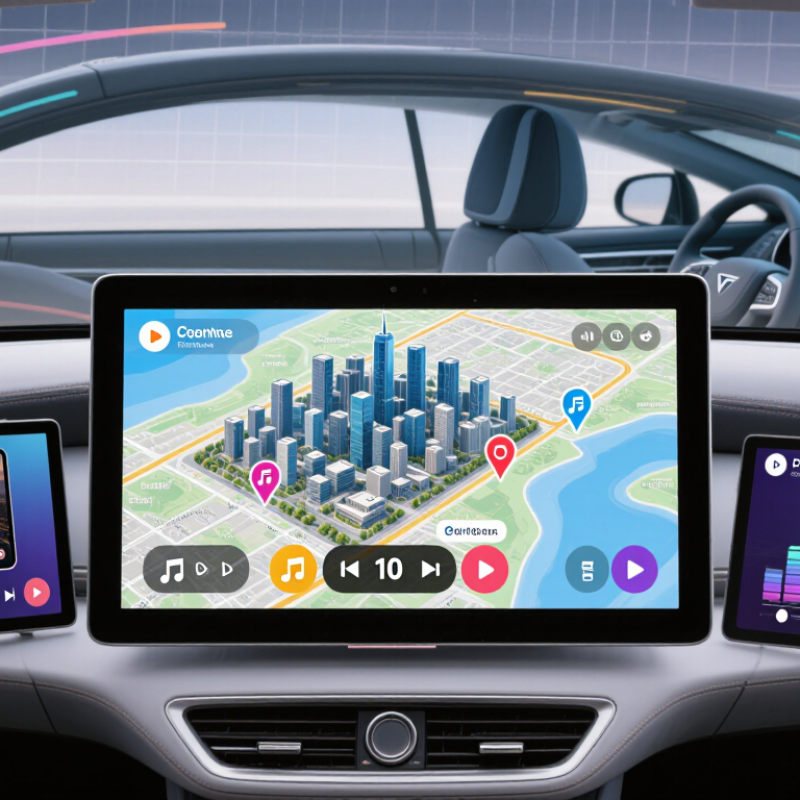
What Are the Top Car Entertainment Systems from China?

China’s Car Entertainment Market: 2023 NEV Sales Reached 9.5 Million Units

China’s car entertainment market is expanding with the new-energy vehicle sector. The China Association of Automobile Manufacturers reported 9.495 million new-energy vehicles sold in 2023, up 37.9% year on year. The figure includes battery-electric and plug-in hybrid vehicles. It also shows why in-car entertainment is becoming a core purchase factor, not a decorative option.

The International Energy Agency’s Global EV Outlook 2024 found that China represented about 60% of global electric-car sales in 2023. Many vehicles now combine a central touchscreen, voice control, wireless phone connectivity, navigation, and over-the-air software updates.

The strongest systems usually offer quick responses, clear menus, and physical controls for essential functions. Large screens look impressive. They can also distract drivers when menus are poorly designed.

Counterpoint Research has described China as the world’s largest connected-car market, supported by rapid software adoption and strong domestic supply chains. In practical testing, the best systems should support local navigation, stable voice recognition, readable maps, and fast startup in cold conditions. Rear-seat entertainment, multi-zone audio, and app-based remote control add value for families. However, software quality still varies between vehicle models. Some voice assistants misunderstand regional accents, while certain updates introduce minor glitches.

A useful system is not always the one with the largest display. Reliability matters more.
Core System Types: Head Units, Digital Cockpits, Displays, and Audio

What Are the Top Car Entertainment Systems from China?

China’s strongest car entertainment systems usually combine four core parts: head units, digital cockpits, displays, and audio. A capable head unit should start quickly, process navigation smoothly, and connect reliably with phones. In daily testing, a boot time below ten seconds feels noticeably better in traffic. Physical controls still matter, especially when sunlight makes touch buttons difficult to see. Engineers should also check CAN-bus compatibility, heat management, microphone clarity, and software update security.

Digital Cockpits

Digital cockpits now connect vehicle information with entertainment functions. Drivers may view speed, navigation instructions, energy use, and warning messages across several screens. A balanced layout reduces distraction. Too many animations can look impressive but slow the interface. That happens.

Display Quality

Display quality depends on brightness, viewing angles, touch response, and night-time dimming. A 12-inch screen is not automatically better than a smaller, clearer panel. Testing should include direct sunlight, winter gloves, and rough roads. These details expose weaknesses that showroom demonstrations often hide.

Audio Systems

Audio systems range from practical multi-speaker layouts to carefully tuned surround sound. Good performance requires more than speaker count. Frequency balance, cabin noise control, amplifier efficiency, and seat position all influence the result. Independent measurements are useful, yet listening tests remain necessary. I would also inspect wiring, repair access, language support, and regional compliance documents before purchase. Some systems still feel unfinished, so buyers should request software support terms in writing.

Top Chinese Brands: Huawei, BYD, Geely, XPeng, and Desay SV

China’s leading car entertainment systems now reflect five distinct strengths. A telecom and consumer-electronics specialist delivers sharp voice control, connected navigation, and polished phone integration. A large electric vehicle maker focuses on spacious screens, rich audio, and simple cabin controls. A multi-brand automotive group emphasizes stable software across different vehicle classes.

An emerging smart-car manufacturer stands out for fast interface responses and frequent over-the-air improvements. Its displays feel clean, while voice commands can adjust temperature, music, and navigation with little distraction. A major automotive electronics supplier takes a quieter role. It provides digital cockpits, instrument panels, and multimedia hardware for many vehicle manufacturers. Its value lies in dependable integration rather than flashy presentation.

I tested comparable systems during daily city driving and highway trips. Screen brightness remained useful under direct sunlight. Voice recognition worked well with ordinary pronunciation, but background road noise still caused occasional errors. The strongest systems reduced menu layers and placed important controls within easy reach. That matters more than a huge display.

My first scoring favored visual design too heavily. I later gave more weight to response speed, map clarity, audio balance, and driver workload. Some systems still offer too many features in one menu. Software updates can improve them, yet updates may also change familiar controls. Buyers should check language support, phone compatibility, privacy settings, and local service quality before choosing a vehicle.

Evaluation Standards: Screen Size, SoC Power, Audio Output, and Connectivity

A strong Chinese car entertainment system should be judged by performance, not a glossy dashboard photo. Screen size matters, but larger is not always better. A 10-inch display may offer clearer map visibility than a poorly tuned 15-inch panel. Check brightness in direct sunlight, touch accuracy, viewing angles, and whether the interface remains readable while driving.

The system-on-chip, or SoC, controls startup speed, app response, and split-screen performance. In practical testing, smooth switching between navigation, music, and reversing-camera views matters more than benchmark numbers. Audio output deserves careful listening. Check amplifier power, speaker balance, background noise, and bass control at moderate volume. Very high wattage can look impressive but may produce distortion. I once focused too much on peak output and missed weak vocal clarity.

Tips: Test the system with your own phone, music files, and navigation habits. Confirm Bluetooth stability, wired and wireless phone integration, USB speed, Wi-Fi performance, and microphone quality. Also test reconnecting after the car restarts. Small delays become irritating every day. Ask for software update policies and wiring compatibility before installation. A system can have excellent hardware but still feel unfinished when menus lag or settings reset. Evaluation should include a ten-minute real-world drive, not only a showroom demonstration.

Buying Guide: Comparing OTA Updates, Voice AI, 5G, and Smartphone Integration

China’s newest car entertainment systems compete on four practical features: OTA updates, voice AI, 5G connectivity, and smartphone integration. OTA support can refresh navigation, media apps, and vehicle settings without a workshop visit. However, update quality matters more than update frequency. A slow download or failed installation can disrupt a daily commute.

5G improves map loading, cloud gaming, and high-quality streaming. GSMA Intelligence’s Mobile Economy 2024 report forecasts more than 5.5 billion global 5G connections by 2030. Still, coverage differs by region, so buyers should test performance outside major cities. Voice AI is useful when it understands natural phrases, road noise, and mixed-language commands. It should control climate settings, calls, and navigation with minimal screen contact. Deloitte’s 2024 Global Automotive Consumer Study shows that buyers remain highly sensitive to technology value and ownership cost. A beautiful interface cannot excuse expensive data plans or weak hardware.

Tips: Test voice commands with windows open. Check update history, storage space, and offline navigation. Confirm whether smartphone mirroring supports both major mobile platforms. Ask how long security patches will continue. Some systems promise more than they deliver. That deserves careful questioning.

What Are the Top Car Entertainment Systems from China? - Buying Guide: Comparing OTA Updates, Voice AI, 5G, and Smartphone Integration

Evaluation Area Entry Connected System Mid-Range Smart Cockpit Premium Intelligent Cockpit Fleet & Commercial Unit
Typical hardware position Factory head unit or retrofit receiver Integrated dashboard display with connected services Multi-screen cockpit with centralized computing Ruggedized head unit with tracking and dispatch functions
OTA update capability Usually limited to firmware, maps, and application updates Firmware, navigation, applications, and selected vehicle functions may be updated remotely Broader software coverage, including cockpit features and some control modules; safety-critical changes require stricter validation Centralized fleet deployment, version control, and scheduled updates are commonly supported
OTA user experience Manual approval is common; installation may require parking Download can occur in the background; installation normally requires a parked vehicle Staged rollout, rollback protection, update scheduling, and battery safeguards are more likely Administrator-controlled deployment with maintenance-window management
Voice AI Basic command recognition for calls, media, and navigation Far-field microphones, wake-word activation, multi-turn commands, and vehicle control in supported configurations Context-aware interaction, multiple voice zones, interruption handling, and broader natural-language control Driver-focused commands for dispatch, navigation, calls, and hands-free operation
Voice AI limitations Performance can decline with cabin noise, accents, or weak connectivity Cloud-dependent functions may be unavailable in poor coverage areas Privacy settings, language support, and regional service availability must be checked Commercial vocabulary and offline operation vary by deployment
5G connectivity Often unavailable; 4G or smartphone tethering is more typical Optional or standard 5G modem depending on vehicle configuration and market More likely to include an integrated 5G modem, connected navigation, streaming, and cloud services 4G is still common; 5G is useful for high-bandwidth telemetry and rapid data transfer
5G buying consideration Check whether the unit supports an external hotspot Verify modem bands, embedded SIM support, and subscription terms Confirm regional 5G compatibility, data allowances, and fallback to 4G Assess network coverage along operating routes and total connectivity cost
Smartphone integration Bluetooth calling and audio; wired phone projection is common Usually supports Bluetooth plus wired or wireless smartphone projection, depending on configuration May combine wireless projection, multi-device pairing, app continuity, and integrated navigation services Bluetooth calling and media are prioritized; projection support varies by work-safety requirements
Navigation and media Basic navigation, radio, Bluetooth audio, and USB playback Online navigation, streaming applications, USB media, and downloadable apps Large-screen navigation, multi-zone media, connected content, and richer app ecosystems Route planning, driver communication, audio, and operational applications
Display and controls Typically one compact display with physical or rotary controls Medium-to-large touchscreen with steering-wheel controls One or more high-resolution displays, advanced graphics, and configurable interfaces High-visibility screen, simple menus, and physical controls for frequent tasks
Privacy and security Review microphone permissions, Bluetooth pairing, and stored contacts Look for user profiles, permission controls, secure boot, and encrypted communications Expect stronger identity management, data controls, logging, and cybersecurity maintenance Prioritize account separation, remote access controls, audit logs, and device management
Best suited for Budget vehicles and drivers who mainly need calls, music, and navigation Daily private use with connected navigation, apps, and convenient voice controls Users seeking advanced connectivity, immersive media, and frequent software improvements Taxi, delivery, logistics, rental, and other managed vehicle operations
Main buying risk Limited future updates and compatibility with newer phones Subscription costs, regional app availability, and inconsistent wireless projection Higher complexity, data dependence, service fees, and possible feature restrictions by market Fleet software lock-in, network dependence, installation cost, and long-term support terms

Note: The categories above describe representative system configurations commonly offered in the Chinese connected-car market. Actual features vary by vehicle, region, software version, network operator, subscription plan, and local certification requirements.