Choosing a Toilet Brush is a small purchase with daily consequences. The wrong design can trap water, hold residue, or leave an awkward gap around the bowl’s rim. The right one should reach hidden areas, rinse clean, and dry without turning the holder into a damp reservoir.
Reliable figures matter, but their limits matter too. The WHO and UNICEF Joint Monitoring Programme reported that 3.5 billion people lacked safely managed sanitation in 2022. That global statistic describes sanitation access, not toilet-brush sales or product performance. Buyers should avoid treating broad hygiene data as proof that one brush material is superior. Product claims deserve scrutiny. Check what the maker actually specifies: bristle material, handle construction, holder ventilation, replacement parts, and care instructions. Look closely at the base. Does water drain, or collect beneath the brush?
Microbiologist Dr. Charles Gerba is known for research on household microbes. A practical takeaway, paraphrasing his hygiene-focused work rather than quoting him verbatim, is: “Choose cleaning tools that can be cleaned and dried—not merely hidden.” That is useful advice. Still, a brush alone cannot guarantee a hygienic bathroom; routine cleaning and proper drying matter. This guide’s ten buying tips will help global buyers compare shape, materials, durability, packaging, and supplier claims. Some details are easy to miss, especially brush-head replacement and holder airflow. They deserve a closer look.
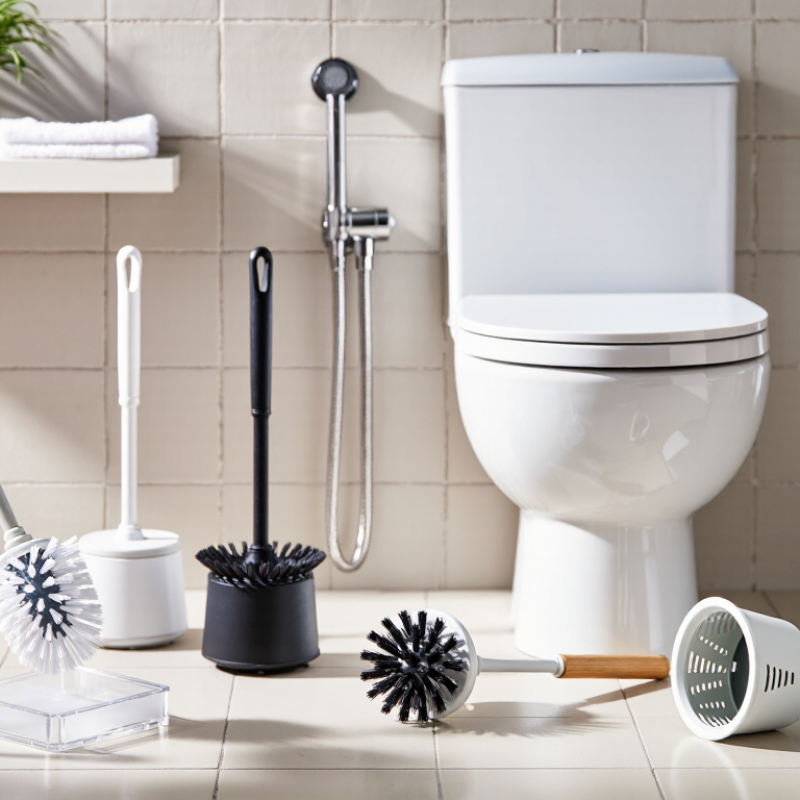
Before requesting quotations, describe where the brush will be used. A guest bathroom in a small apartment has different needs from a busy hotel washroom. Note user groups, cleaning frequency, and available storage space. Measure the space beside the toilet and the vertical clearance for the handle and holder. Small details matter.
Decide whether daily household cleaning, frequent shared use, or occasional maintenance sets the priority. For regular use, compare bristle density, handle grip, and resistance to bending. Ask suppliers for material specifications. A compact head may reach under the rim, but an overly small one can slow cleaning. There is a trade-off. Consider whether a replaceable head suits your maintenance routine instead of assuming it does.
Match the holder to its placement. An enclosed design reduces visual clutter, while an open one may dry faster, depending on airflow and cleaning habits. Consider wet floors and who will wash the holder. Request a sample and test it in a real bathroom; catalogue photos cannot show reach or balance. I would record the results, even if the checklist feels fussy. Confirm carton dimensions, unit weight, and color tolerances before bulk ordering, since transport and storage affect total cost. Some buyers overlook this.

Choosing a toilet brush for a global market starts with the cleaning task and storage conditions. Round bristle heads reach beneath the rim and scrub textured bowls effectively. Flat silicone heads rinse clean quickly and may collect less visible debris, but they can struggle with dried residue. Neither type is automatically better. Compare head shape, flexibility, and replacement availability before choosing.
Material affects durability and upkeep. Nylon bristles are flexible and familiar, while silicone is easy to rinse and less likely to hold water between uses. Handles made from polypropylene are lightweight; stainless steel can feel sturdier, though its finish and joints still need inspection. Look closely at where the head connects to the handle. A loose joint can make even a good brush frustrating.
Handle design matters during daily use. A longer handle keeps hands farther from the bowl, while a textured grip helps when wet. Check that the holder allows drainage and does not trap water on the floor. For a practical sample check, test the brush on curved areas and beneath the rim, then see how easily it rinses and stores. These details are easy to overlook. I would not assume one design suits every household; storage space and cleaning habits change the choice.
A toilet brush should remove residue from the bowl curve and rim without requiring heavy pressure. Compare bristle density, head shape, and handle reach; a narrow head can miss the waterline, while overly stiff bristles may scratch delicate finishes. Ask suppliers for repeatable cleaning or abrasion test results, not just “deep-clean” claims. Better evidence.
Hygiene depends on what happens after scrubbing. A ventilated holder that lets the head drip-dry is preferable to a sealed, wet cup. NSF International’s 2011 Household Germ Study tested surfaces in 22 homes and found coliform bacteria on 64% of sampled toothbrush holders. That finding does not measure toilet brushes, but it shows why damp bathroom storage deserves attention. For durability, check bristle retention, handle-to-head joints, corrosion resistance, and whether replacement heads are available. Request cycle-test methods and results; “long-lasting” alone is hard to verify. A tidy specification sheet still cannot predict every bathroom, so trial samples under real cleaning routines before committing to a large order.
| Buying tip | What to evaluate | Practical checks | Why it matters |
|---|---|---|---|
| 1. Match the brush head to bowl shape | Head profile, width, and access beneath the rim | Test on representative round, elongated, and rimless bowls; check that the head reaches the trapway and underside of the rim. | A suitable shape improves coverage and reduces missed areas or awkward handling. |
| 2. Compare cleaning performance | Debris removal, contact area, and cleaning effort | Use a consistent cleaning test across samples, with the same soil, number of strokes, and rinsing conditions. | A repeatable comparison is more useful than relying on bristle appearance alone. |
| 3. Check bristle stiffness and retention | Bristle flexibility, recovery, shedding, and secure attachment | Inspect for loose or uneven bristles, then flex and rinse the head repeatedly to check for visible shedding or permanent deformation. | Bristles that are too soft may clean less effectively; overly stiff bristles can be harder to control and may scratch some surfaces. |
| 4. Assess water drainage and drying | Holder ventilation, drainage openings, and water retention | After rinsing, place the brush in its holder and check for pooling, dripping onto the floor, and airflow around the head. | Better drainage and airflow can help the brush dry between uses and make the holder easier to clean. |
| 5. Evaluate handle grip and reach | Handle length, grip texture, balance, and connection strength | Check comfortable reach without excessive bending; inspect the joint between handle and head for looseness during use. | A secure, manageable handle supports controlled cleaning and reduces strain or breakage risk. |
| 6. Inspect materials and corrosion resistance | Material composition, finish, and resistance to routine bathroom exposure | Request material specifications; examine metal parts for exposed edges or damaged finishes and test samples in humid conditions. | Bathrooms are frequently damp, so material and finish quality affect appearance and service life. |
| 7. Review cleanability and replacement options | Accessible surfaces, detachable heads, and replacement-part availability | Look for hard-to-reach crevices and confirm how the holder and head can be cleaned or replaced. | Simple maintenance supports better hygiene and can reduce the need to discard the entire product. |
| 8. Check stability and storage footprint | Base stability, holder dimensions, and brush retention | Place the holder on typical bathroom flooring and test whether it tips, slides, or allows the brush to fall out. | A stable holder is safer and helps contain drips while fitting available storage space. |
| 9. Verify durability with cycle testing | Handle, head joint, bristles, and holder after repeated use | Agree on a documented use-cycle test and inspect for cracks, loosening, rust, bristle loss, and deformation at defined intervals. | A consistent test helps compare samples; results should be treated as test-specific rather than a guaranteed service life. |
| 10. Confirm market and packaging requirements | Applicable local rules, labeling, dimensions, and transport packaging | Check destination-market requirements, verify carton dimensions and packing quantities, and inspect packaging for damage protection and handling information. | Requirements vary by destination, while suitable packaging helps protect goods during storage and shipping. |
For a toilet brush, safety checks should match the destination market and the materials used. Ask for current test reports and material declarations, not just a general certificate. Check that the handle withstands twisting, the bristles stay firmly attached, and exposed edges feel smooth. Request compatibility checks with common bathroom cleaners; a brush can look sturdy yet loosen after repeated use. One detail is easy to miss: test samples should match the final production materials. I would not treat a tidy document as proof of every batch’s quality.
Packaging deserves equal attention. The OECD’s 2022 Global Plastics Outlook reports that packaging generated about 40% of global plastic waste in 2019. That figure covers all packaging, not toilet brushes specifically, but it makes packaging choices worth reviewing. Ask suppliers for options such as recycled-content cartons, reduced plastic sleeves, and clear disposal instructions, then confirm protection during shipping. A damp warehouse can weaken paperboard, so request drop and moisture checks for the actual box design. Customization may include handle colors, printed labels, carton dimensions, or private instructions. Keep artwork readable at small sizes, and approve a physical sample before mass production. Small print can disappear.
For global buyers, a toilet brush’s unit price is only one part of the purchase cost. Compare suppliers using the same specifications: brush-head dimensions, bristle material, handle length, holder design, packaging, and carton quantity. Request a sample and a written quotation with production time and quality checks. Small details matter. A holder that leaks during transit can turn a low quote into an expensive problem.
Tip: Calculate landed cost, not just factory price. Include packaging, inspection, freight, insurance, and applicable import charges. Ask suppliers to separate these items in their quotes, then check whether the price changes with order volume or material choices. The UNCTAD Review of Maritime Transport 2024 reports that shipping carries over 80% of world merchandise trade by volume. This makes freight assumptions worth checking closely, especially for bulky cartons.
Before paying, confirm the shipping route, shipment size, estimated dispatch date, and delivery term in writing. Clarify who books transport, handles export documents, and pays charges at each stage. Compare quotes on matching terms; otherwise, a cheaper offer may exclude costs shown in another supplier’s quote. Tip: Ask for carton dimensions and gross weight, not only the number of brushes. These figures help a forwarder estimate space and freight. Also confirm how delays or damaged cartons are reported. I would still recheck the final booking details—supplier quotes can be incomplete.
Suggested allocation of a 100-point supplier and purchasing evaluation: compare product quality, commercial terms, and international shipping readiness.
Illustrative evaluation framework, not market-survey data. Adapt the weights to your product specifications, destination market, and sourcing priorities.


