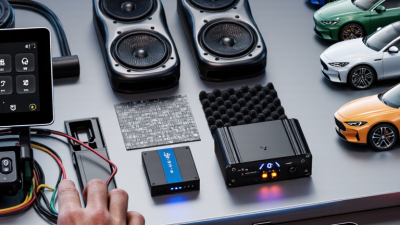
Choosing a top China car audio installation supplier requires more than comparing factory prices. The decision affects sound quality, vehicle safety, warranty support, and customer trust. Grand View Research reports that the global automotive audio market is expanding steadily, driven by connected vehicles, premium sound systems, and demand for personalized in-car entertainment. This growth creates opportunities, but it also makes supplier screening more important.
Richard Clark, a respected car audio educator and competition expert, once said, “The goal of a car audio system is to reproduce the music as accurately as possible.” His principle remains practical. A capable supplier should understand speaker positioning, amplifier matching, digital signal processing, wiring protection, and acoustic treatment. Ask for installation photographs, wiring diagrams, test records, and references from comparable vehicles. A polished showroom is not enough.
Look closely at production details. Are connectors sealed against moisture? Are amplifier racks ventilated? Can the supplier explain impedance, power handling, and tuning in plain English? The answer matters. A reliable China supplier should provide clear specifications, stable quality control, sample testing, and responsive after-sales service. Certifications and export experience also deserve verification, not assumptions.
Some buyers focus too heavily on low quotations. I have seen that approach create expensive rework. Cheap labor may hide weak tuning or poor cable routing. That risk is easy to underestimate. The best car audio installation partner combines engineering discipline with practical installation experience. Still, no supplier is perfect. Request a pilot order, inspect the first installation, and document every weakness before scaling the relationship.
A reliable supplier search begins with a precise installation brief. Record your vehicle model, factory head unit, speaker sizes, and available mounting depth. Note your listening habits too. Clear vocals need different tuning from powerful bass. A practical plan should also include your budget, preferred components, wiring needs, and installation location.
S&P Global Mobility reported that the average age of light vehicles in operation reached 12.6 years in 2024. Older vehicles often require integration with original wiring and limited dashboard space. Ask suppliers to explain signal compatibility, amplifier load, sound deadening, DSP tuning, and warranty support. Request installation drawings and test procedures. I once treated wattage as the main quality indicator. That was a weak assumption. Sensitivity, impedance, enclosure volume, and tuning can matter more.
Tips: Send photos of the dashboard, door panels, and existing connectors. Include exact dimensions. Ask for a wiring diagram before ordering. A supplier that asks detailed questions may be more dependable than one offering instant prices. The Automotive Aftermarket Suppliers Association emphasizes accurate vehicle-fit information as a key part of aftermarket service quality. Still, specifications can be incomplete. Confirm measurements locally before production, especially for custom brackets and subwoofer enclosures.
Choosing a top China car audio installation supplier requires more than comparing online prices. Examine the team’s practical experience with different vehicle structures, wiring systems, and dashboard layouts. Ask for recent installation photos, test records, and clear explanations of their fitting process. A knowledgeable supplier should discuss sound tuning, power matching, heat control, and possible interference without making exaggerated promises. Real expertise sounds specific.
Product quality deserves close attention. Request samples and inspect connector strength, cable insulation, metal finishing, and speaker diaphragm consistency. Reliable suppliers should explain their incoming-material checks and final performance tests. Certifications can support this evidence. Check whether ISO 9001, IATF 16949, EMC, or RoHS documents are current, relevant, and issued to the correct factory. A certificate image alone proves little. I once trusted polished paperwork too quickly, and that was a mistake worth remembering.
Tips: Visit the production site through video or in person. Ask for batch traceability and failure-rate data. Confirm warranty handling in writing. Compare test results under the same conditions, not attractive claims. Allow an independent technician to review samples. Small details matter. Also, leave room for questions; a supplier that admits a limitation may be more dependable than one promising perfect sound every time.
Choosing a top China car audio installation supplier requires more than checking a low quotation. Customization, pricing, and minimum order quantities reveal the supplier’s real capabilities.
Ask whether the factory can adjust speaker sizes, amplifier layouts, wiring lengths, connector types, and dashboard mounting kits. Request drawings, material samples, and a working prototype before mass production. A reliable supplier should explain power ratings, impedance, heat control, and installation compatibility in clear terms. Vague answers deserve caution.
Very low prices may hide thin wiring, weak connectors, or limited testing. That lesson is easy to learn too late.
Compare quotations line by line. Check tooling fees, sample charges, packaging, inspection, and shipping terms. Ask which costs change when the order quantity increases. Some suppliers offer flexible customization but require a high minimum order. Others accept smaller batches but charge more per unit. Neither option is automatically better.
A trial order can expose inconsistent sound output or poor fitment. It may also strain your budget. Be honest about that risk.
Confirm the minimum order for standard products and customized parts separately. Ask how the supplier handles design revisions, replacement parts, and quality claims.
Production photos, test reports, and clear payment milestones improve reliability. However, documents alone do not prove performance. Test several units under heat, vibration, and continuous playback. Record every result. A supplier that welcomes technical questions is usually easier to manage, though even a cooperative factory can make mistakes during a rushed production run.
Choosing a China car audio installation supplier starts with evidence, not attractive samples. During factory visits, I check SMT lines, final assembly capacity, staffing, and backup equipment. OICA reported 93.5 million motor vehicles produced worldwide in 2023. A capable supplier should explain its monthly output clearly. Ask for production records. Photos are not proof.
Testing must reflect real vehicle conditions. ISO 16750 covers environmental stresses, while CISPR 25 addresses radio disturbance. ISO 7637-2 examines electrical transients from vehicle power systems. Request calibration certificates, test reports, traceability records, and documented failure actions. The reports should identify test dates, instruments, samples, and acceptance limits. A polished laboratory can still hide weak processes. No audit is perfect.
Delivery terms need equal attention. UNCTAD’s Review of Maritime Transport 2024 states that maritime shipping carries over 80% of global merchandise trade by volume. Confirm the Incoterms 2020 rule, port responsibility, export documents, insurance, and customs duties. Compare production lead time with actual shipping history, not promises. Ask for on-time delivery data, carton drop-test results, and contingency plans for port disruption. I prefer written milestones: approved sample, pilot run, inspection, dispatch, and arrival. Small omissions become expensive delays. Allow a realistic buffer.
| Evaluation Dimension | Recommended Verification Benchmark | Evidence to Request | Why It Matters for Car Audio Installation Projects | Assessment |
|---|---|---|---|---|
| Manufacturing Capacity | Dedicated production areas for PCB assembly, wiring harnesses, enclosure assembly, software loading, and final inspection. | Factory layout, process-flow chart, equipment list, production-line photographs, and an on-site or live video audit. | Confirms that the supplier controls key processes instead of relying entirely on uncontrolled subcontracting. | Must Verify |
| Monthly Output Planning | Capacity should be stated by product model and shift pattern, with separate figures for sample production and mass production. | Capacity statement showing units per shift, number of shifts, bottleneck operations, and current utilization. | Prevents a supplier from quoting total theoretical capacity that cannot support the required delivery schedule. | Must Verify |
| Production Traceability | Serialized or lot-based records linking incoming materials, operators, test results, firmware version, and shipment carton. | Redacted traceability record, barcode workflow, lot-control procedure, and sample certificate of conformity. | Enables faster root-cause analysis and controlled replacement if a field failure occurs. | High Priority |
| Quality Management | Documented quality system aligned with ISO 9001:2015 principles; automotive-focused projects benefit from IATF 16949-based controls. | Valid certificate scope, audit report summary, corrective-action records, incoming inspection plan, and process-control plan. | Shows whether quality activities are systematic, documented, and subject to continual improvement. | High Priority |
| Automotive EMC Testing | Testing should address applicable vehicle electromagnetic compatibility requirements, such as UN ECE R10 where required, plus customer-specific limits. | Test reports from a competent laboratory, test setup, sample configuration, software version, and pass/fail criteria. | Reduces risks of radio interference, malfunction, or incompatibility with the vehicle electrical system. | Must Verify |
| Conducted Transient Immunity | Automotive power-input testing should consider ISO 7637-2 pulse conditions when applicable to the product and vehicle architecture. | Test report identifying pulse levels, polarity, duration, source impedance, operating mode, and functional-performance criteria. | Helps verify resistance to load switching and electrical transients on 12 V or 24 V vehicle networks. | Must Verify |
| Environmental Reliability | Validation should cover temperature cycling, high and low temperature operation, vibration, humidity, and mechanical shock according to the agreed product specification. | Reliability test matrix, sample size, duration, acceptance criteria, failure analysis, and retest records. | Car interiors expose audio equipment to temperature changes, vibration, condensation, and long operating periods. | High Priority |
| Audio Performance | Use defined measurements for frequency response, total harmonic distortion, signal-to-noise ratio, channel balance, output power, and microphone performance where applicable. | End-of-line test limits, calibrated instrument list, test fixtures, sample measurement reports, and failure-disposition records. | Objective limits provide more reliable quality control than subjective listening checks alone. | Must Verify |
| Installation Compatibility | Confirm compatibility with the target vehicle interfaces, steering-wheel controls, factory amplifiers, cameras, sensors, antennas, and vehicle communication networks. | Compatibility matrix, wiring diagrams, installation manual, vehicle test list, and documented software version control. | Reduces installation time, integration errors, customer complaints, and the risk of vehicle-function interference. | Must Verify |
| Sample Approval | Use an approved pre-production sample or golden sample before mass production; changes require written approval. | Signed sample approval, bill of materials, approved drawings, firmware checksum, cosmetic standard, and change-control form. | Ensures that production units match the version tested and approved by the buyer. | High Priority |
| Incoming Material Control | Critical components should have defined inspection criteria, supplier lot control, and verification of electrical and mechanical specifications. | Approved supplier list, incoming inspection records, component certificates, sampling plan, and nonconforming-material procedure. | Many audio failures originate from inconsistent connectors, capacitors, displays, wiring, or power components. | Recommended |
| Packaging and Shipping Protection | Packaging should protect against vibration, compression, moisture, electrostatic discharge, and connector or display damage during transport. | Packaging specification, carton dimensions, drop-test record, palletization plan, moisture protection method, and product labeling sample. | Good packaging reduces transit damage and simplifies warehouse receiving and installation handling. | Recommended |
| Lead-Time Definition | Separate sample lead time, tooling lead time, first-production lead time, repeat-order lead time, and documentation approval time. | Written production schedule with milestone dates, dependencies, buffer assumptions, and escalation contacts. | A single average lead-time number can hide approval, material, tooling, and production constraints. | Must Verify |
| Delivery Terms | Specify the applicable Incoterms® 2020 rule, named place, export responsibility, insurance responsibility, freight method, and transfer of risk. | Quotation and sales contract showing the exact term, named destination, included charges, exclusions, and shipping documents. | Clear delivery terms prevent disputes over freight, customs clearance, insurance, unloading, and delivery responsibility. | Must Verify |
| Shipment Documentation | Commercial invoice, packing list, transport document, certificate of origin when required, product labels, and conformity documents should match the shipment. | Redacted document package from a previous shipment and a document checklist agreed before dispatch. | Accurate documents support customs clearance, receiving inspection, and warranty traceability. | High Priority |
| Warranty and After-Sales Support | Define warranty period, defect classification, response time, replacement or repair process, freight responsibility, and technical-support channel. | Warranty policy, return-material authorization procedure, failure-analysis template, spare-parts plan, and service-level commitments. | Installation projects require predictable support when compatibility or field failures appear after deployment. | High Priority |
| Commercial Risk Control | Payment milestones should connect to measurable deliverables such as sample approval, production completion, inspection, and shipment documentation. | Draft purchase agreement, inspection clause, acceptable-quality-limit plan, change-control clause, and cancellation terms. | Milestone-based controls reduce exposure before the supplier has demonstrated production and delivery performance. | Recommended |
| Supplier Selection Decision | Use a weighted scorecard; a practical structure is manufacturing capacity 25%, testing and quality 30%, compatibility 20%, delivery 15%, and service/commercial terms 10%. | Completed audit scorecard, evidence links, open-risk register, corrective-action deadline, and final approval record. | A documented scoring method makes supplier comparisons more objective and highlights risks that price alone cannot show. | Best Practice |

How to Choose a Top China Car Audio Installation Supplier?
A capable supplier communicates before the first wire is cut. Ask for a wiring plan, vehicle compatibility list, and installation timeline. Request photos of completed dashboards, cable routing, and sound-deadening work. Clear replies matter. PwC’s Future of Customer Experience report found that 32% of customers would leave a company after one bad experience. Delayed replies may signal deeper project risks. Confirm who handles technical questions, time-zone differences, and design changes.
Installation support should include vehicle-specific diagrams, fitting guidance, and remote troubleshooting. Ask whether engineers can review photos or join a video call during installation. J.D. Power’s 2024 U.S. Customer Service Index Study evaluates service quality, advisor communication, and repair initiation. These areas also apply to audio upgrades. A supplier may offer excellent equipment, yet weak instructions can create rattles, signal noise, or unsafe cable placement. That is easy to underestimate.
Tips: Put after-sales promises in writing. Check response times before ordering. Ask for spare-part procedures, warranty periods, and escalation contacts. Test one technical question first. Notice the answer’s detail. A perfect checklist is impossible. I would still inspect failure handling, not only successful installations. Require a photo-based acceptance record, including amplifier settings, fuse locations, and final sound testing.